Services
Projects
Blog & Podcast Lifestyle & Wellbeing


Food & Nutrition

Retail & Ecommerce
A conversation with ultra marathon runner Juju Kim about niches, audiences, and the moment you realize the work isn't what you thought it was.

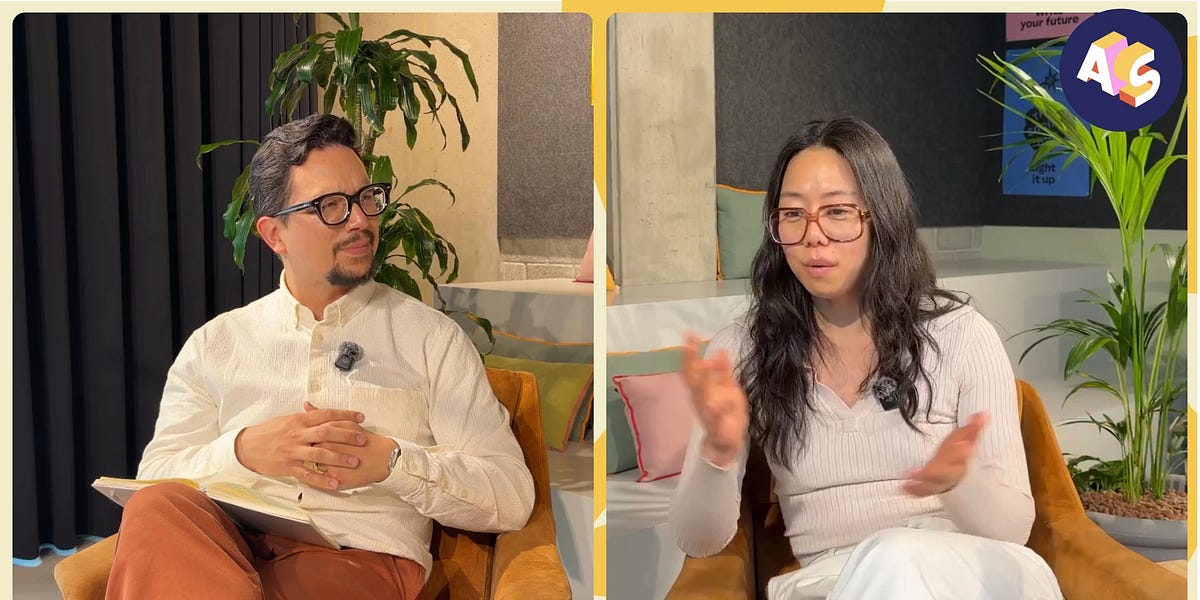
“Everything you build eventually teaches you something about yourself. The question is, are you paying attention to learn it?”
I said that in the open of this week’s episode. I want to write about why, because the conversation I had with Juju Kim is the one I’ve been thinking about most since we wrapped.
Juju is an ultra marathon runner and content creator. She ran from LA to Las Vegas last year. She is training for 500 kilometers across the Atacama in November. On her feed she looks like a running creator. The frame everyone reaches for is athletic. But if you watch her work long enough, the running isn’t really the subject.
The subject is a person who, two years ago, was rotting in bed for months after a breakup, doom-scrolling through the worst of it. She made herself a small deal: if you’re going to rot, run for twenty minutes a day. Then a second deal: if you’re going to doom-scroll, make one video.
What she films now is the inside of that promise, still being kept.
I went into this interview thinking we were going to talk about running. We talked about so much more than that.
The thing that struck me most about Juju is not the distance or the discipline. It’s that she is one of the few creators I have ever talked to who can tell you what her audience is actually responding to.
Most creators I meet — most founders too — describe their work as if the work itself is the product. The video is the product. The race is the product. The app is the product. So they optimize the product. They polish it, sharpen it, scale it, repeat what worked.
Juju doesn’t describe her work that way. She told me she’s “literally making the same video every day” — showing up on the days she feels gross, showing up on the days she has a cute outfit, showing up on the days she doesn’t want to. The race is a milestone in that record. The ugly day with no makeup and no plan is also a milestone in that record. She films both on purpose. Both are the work.
That sounds like a small reframe. It isn’t. It changes what the audience is actually buying.
When she started, her why was survival. Get off the couch. Move. Don’t rot.
Her why now is different. Somewhere in the last year, in race after race, she started noticing she was the only Asian woman on a lot of start lines. That changed something. Her why became: show my younger self, and other women who don’t see themselves in this space, that we can take up room here.
The why keeps changing. And the product — her content — has to catch up to the why. That’s the pivot. That’s the part most creators and most founders get wrong.
I built a product called the Five Minute Journal twice. Version two and version three. The business metrics mattered, but the thing I remember most clearly is one review. A long one. Someone described what they had lost, and what they were doing now to get themselves back, and how the journal was one of the tools they were using alongside professional help.
That review didn’t move the metrics. But it told me what the product was actually for. The why underneath it had shifted from “build a productivity tool” to “give people a way to notice themselves while they heal.” The product had to catch up.
This is what Juju and I kept circling. Being done isn’t done. It’s just the next point to grow from.
There’s a moment from the LA-to-Vegas race that I keep coming back to. By day six Juju was in serious pain — last twenty kilometers, body shutting down. Lucy, who started Team Solo to get more women to this start line, looked at her and said: you’re doing well, go ahead and finish, you don’t have to wait for us.
Juju said no.
She said: if you’d told me that on day one, I would have gone. But it’s day six. And I think about what you told me — that running is a team sport. We finish together. I would never have made it this far without my team. So no.
That’s not a content moment. That’s a person being changed by the practice she’s inside of, in real time, with a camera running. That’s what the audience is actually responding to.
I’ve built a few products. I have advised many more. Almost every time a product reaches the moment where it starts to find an audience, the same temptation shows up.
Optimize the artifact.
It’s a sensible instinct. Something is working — do more of it. But it is also the moment where the most important thing about the product — the specific person who made it from a specific reason — starts to get edited out in the name of growth. Polish replaces presence. Best practices replace the original argument. The product becomes legible to a broader audience and quietly stops being interesting to the people who showed up first.
The trade is rarely conscious. It almost never feels like a decision. It feels like maturity.
What I saw in Juju is somebody who has not made that trade. The artifact has gotten better. The races have gotten longer. The production has gotten cleaner. But the person inside the work is still locatable. You can still find the woman who was in bed. That is not nostalgia. That is the entire reason her audience is there.
The question I think every founder and every creator should be sitting with right now, while the cost of producing the artifact is collapsing toward zero, is the inverse of the question they’ve been trained to ask.
The old question was: how do we make more of it, faster, cheaper, smoother.
The question I think actually matters now is: is the person who started this still locatable inside it.
If yes, the work can scale and the relationship will hold. If no, you can scale forever and the audience will quietly drift somewhere else, looking for the next person they can feel inside the work.
Juju cannot be replicated by a tool. Not because of what she runs or how she films — those are reproducible — but because what she is actually transmitting is a relationship between her own life and her own work that nobody else has standing to make.
That’s the only moat that gets stronger over time, not weaker.
If you make things, in public, for an audience: this week, watch your own work the way Juju’s audience watches her. Not the metrics. The other thing. The thing you might be quietly editing out.
That thing is probably the work.
— Tom

