Services
Projects
Blog & Podcast Lifestyle & Wellbeing


Food & Nutrition

Retail & Ecommerce
Real connection is not a feature problem. It is a practice problem. Cynthia Mensah-Neglokpe has spent years showing how to build it.

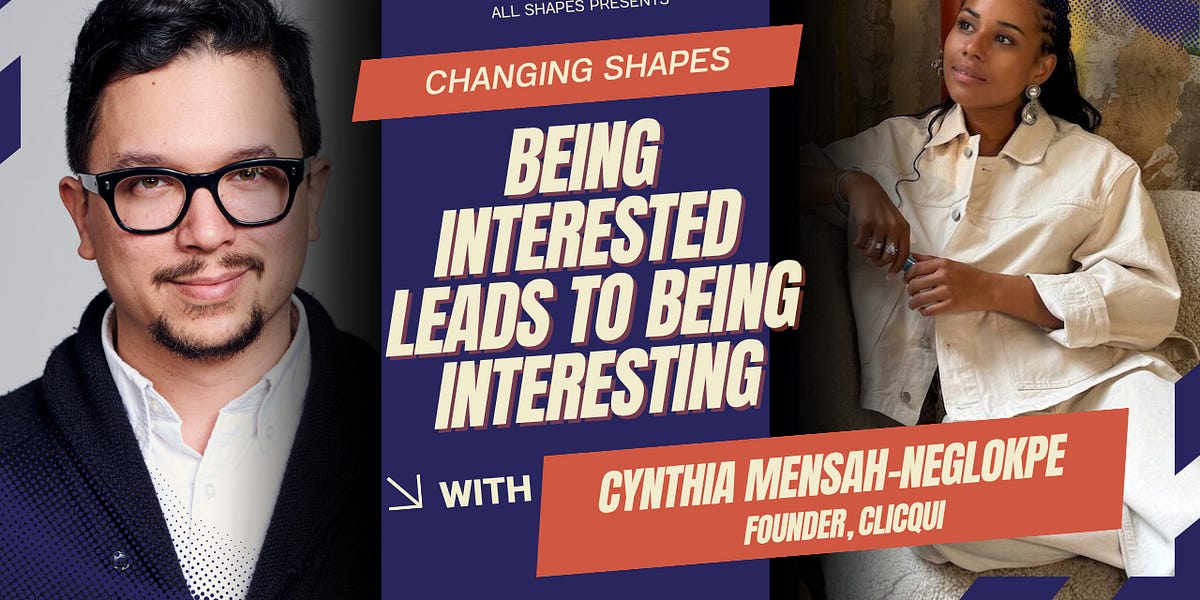
Changing Shapes is a podcast for founders, builders and operators who want to build things that connect with the people who use them. Host Tom Horak, founder of All Shapes, talks with people who have built that relationship between product and audience, and gets them to walk through exactly how.
The technology industry has been selling a version of connection for fifteen years, and the data is in. People are lonelier than they have ever been. Now the same industry is proposing AI companions to fix loneliness.
If you build products or communities for a living, this matters: it means the failure is not just in what we ship, but in what we choose to design for.
Cynthia Mensah‑Neglokpe runs a different experiment. She invites twelve women to dinner. She has been doing this for years, in cities across Europe, and what she has built is one of the most carefully constructed proofs in the wild that real connection is not a feature problem. It is a practice problem.
The same argument runs through the way Cynthia talks about brands and community. Most brands, she says, confuse a follower count with a community. They have customers, often loyal ones, who like the product and tell other people about it. That is not a community. A community is built through the same practices a host uses at a dinner. Listening, remembering, asking, making space. The brands that get this build with their customers. The brands that don’t are running engagement metrics on people who never agreed to be in a relationship with them.
Tom’s product position lands in the same place. The digital products that matter, he says, are the ones that get you off the screen. Products that help you organise a gathering, track your real friendships, find your actual neighbours, show up for someone going through a hard time. The app has done its job when you put it away.
If you build products, the design constraints look something like this:
– Your product should make it easier to show up for people in small, uncomfortable, embodied ways.
– The most important “feature” is often a format or practice (twelve‑person dinners, hosts who notice the quiet person) rather than a clever interface.
– The right success metric is what happens in the room after someone closes your app, not how long you kept them inside it.
– Any move that removes all friction is probably removing the very thing that makes the experience matter.
If you build things, the takeaway from Cynthia’s episode is hard to miss. The discomfort you are trying to design out of the experience is probably the thing that would make the experience matter. The friction is the connection. The asking is the practice. The dinner is what your product is competing against. Twelve people, real names, real conversation, the slight awkwardness of strangers becoming friends. That is what it should be trying to support.
Listen to the full episode on Apple Podcasts, Spotify or YouTube.
Tom Horak is the founder of All Shapes, a strategy, design and development studio behind products including Five Minute Journal and Doctor’s Kitchen. He started his career in fine art and has spent over a decade thinking about what makes the relationship between a product and its audience hold up. On LinkedIn here.
Changing Shapes lands here every week. Subscribe to get new episodes and essays in your inbox.
Recorded at The Social Hub Berlin.

